When most people think of the international community at Forman Christian College, they picture the institution’s deep American roots, the Presbyterian missionaries who founded it in 1864, the generations of Western educators who shaped its identity, the U.S.-based supporters who sustain it today.
But there is another thread in Forman’s international story that is quieter, deeper, and increasingly vital. It is Korea.
Across the campus in Lahore, Korean educators, researchers, and musicians are living, teaching, researching, and worshipping – contributing to the life of this 160-year-old institution in ways that touch nearly every dimension of what Forman does. From the music program to groundwater science, from trauma care to academic leadership, from language instruction to student exchange, the Korean presence at Forman is not a footnote. It is a defining feature of the university’s present and future.
The Sound of Campus
Ask anyone at Forman about the music program and the conversation will turn quickly to Miss Joy.
A Korean musician living on campus, Miss Joy, has transformed the College’s musical life. She directs the Christmas recitals and other performances that have become landmarks of the academic year. And she wrote the music to the Forman College song, a composition that now belongs to the identity of the institution itself.
It is a remarkable thing: a Korean musician, living in Lahore, composing the song that thousands of Pakistani students will carry with them for the rest of their lives.
Solving Pakistan’s Water Crisis
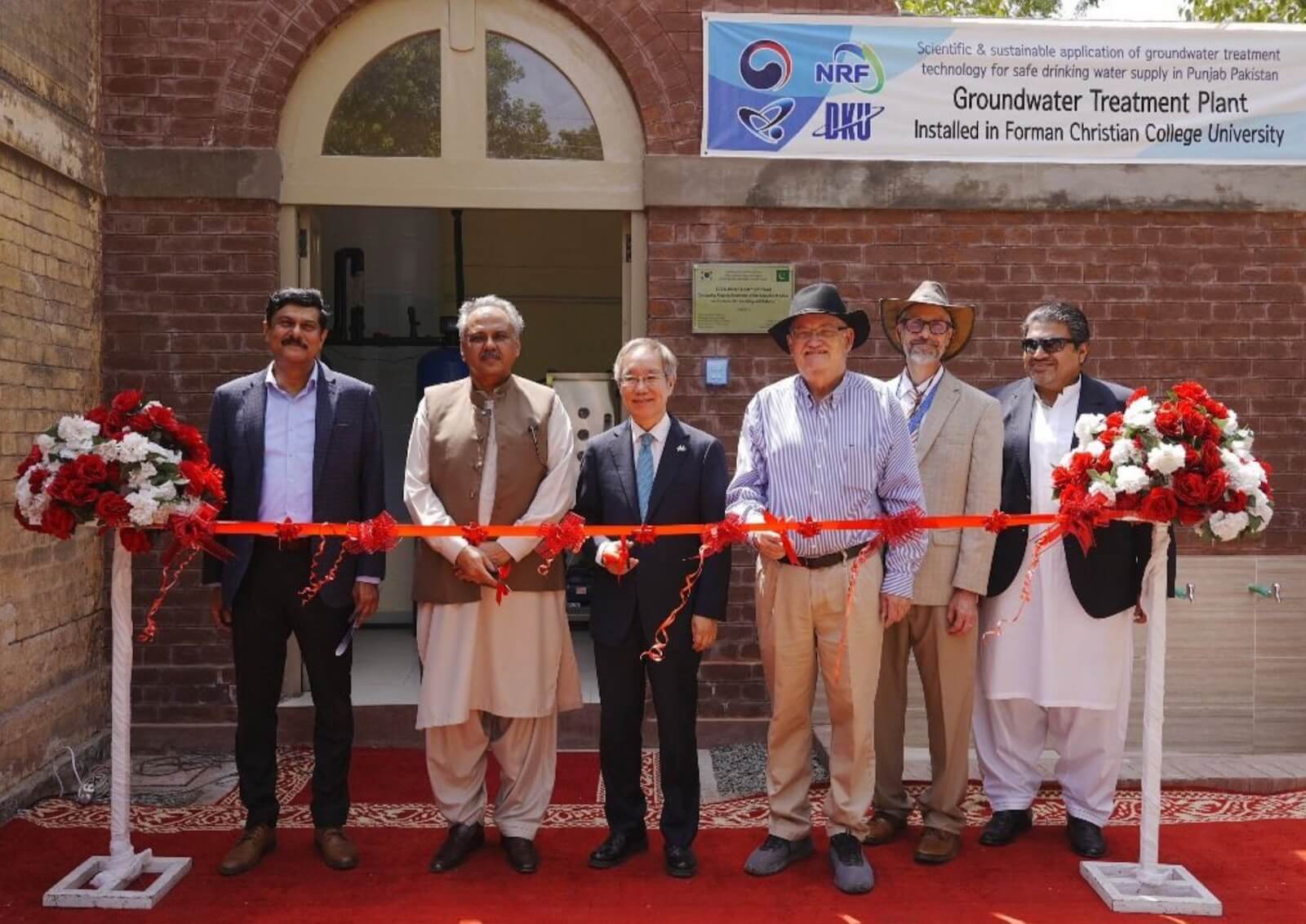
Dr. Shinho heads Forman’s Environmental Studies Department and has been instrumental in securing a major contribution from a Korean international aid program one with implications far beyond the campus.
Through this partnership, Forman has established a water analysis center on campus and two pilot groundwater treatment plants in Punjab: one at Forman itself and the other in the district of Kasur. In a country where groundwater contamination is one of the most urgent public health challenges, this work is not academic. It is lifesaving.
The fact that a Korean scientist at a Pakistani Christian university is leading this effort with support from a Korean aid program speaks to the kind of cross-border collaboration that defines Forman at its best.
From Peshawar to Jeju: A Ministry of Healing
Dr. Matthew may be the Korean most fluent in Urdu in all of Pakistan. He delivers sermons in Urdu and has contributed to Forman’s mission for years. But his most profound work has been in the field of trauma care.
Following the All Souls Church bombing in Peshawar in 2013, an attack that killed 127 people. Dr. Matthew provided direct assistance to victims and their families. That experience led him to connections between trauma care expertise in Pakistan and Korea, particularly in the wake of the Jeju Ferry disaster in 2014, in which approximately 250 school children lost their lives.
Dr. Matthew’s work represents the kind of ministry that may not make headlines but changes lives in the most difficult circumstances.
Language, Leadership, and the Next Generation
The Korean contribution to Forman extends across the academic structure of the university.
Dr. Ruth Park heads the Forman Language Center, which teaches French, German, Spanish, and Korean. She was also instrumental in obtaining a grant from the French Embassy to support the university’s French language program. A Korean educator securing French funding for a Pakistani institution. That sentence alone captures the international reach of Forman’s community.
Dr. Song serves as Associate Dean for Academic Affairs, working at the heart of the Vice Rector’s Office alongside Dr. Trimble and Dr. Gloria. Her role places Korean leadership at the center of Forman’s academic administration.
And later this year, Joshua Moon and his family are expected to join the Forman community at the college level. Joshua is a Korean “missionary kid” who attended Murree Christian School in Pakistan, and his parents still serve as Korean missionaries in the country. He will work alongside Susan Bakker in providing guidance to Christian college students, bringing a unique perspective shaped by a lifetime at the intersection of Korean faith and Pakistani culture.
A Congregation and a Bridge
For many years, Forman has provided space for a Korean-language congregation that meets on campus. The origins of this community trace back to a Korean company that won a contract to build roads in Pakistan, bringing a group of Korean engineers to Lahore. What began as a small gathering of expatriates became an established congregation, one more thread in the tapestry of faith that defines this campus.
Meanwhile, Forman’s international exchange program with Handong Global University in Korea enables FCCU students to study abroad for a semester while remaining enrolled at Forman. It is one of the university’s most popular programs, giving Pakistani students first-hand experience of Korean culture, education, and daily life.
More Than a Connection
What is happening between Korea and Forman Christian College is more than an international partnership. It is a community.
Koreans at Forman Christian College are not visiting. They are living there, raising children, leading departments, writing music, treating trauma, teaching languages, and worshipping alongside Pakistani colleagues and students. They are woven into the daily life of an institution that has always been defined by the willingness of people from different places to commit to a shared mission.
That mission, educating across boundaries, developing leaders, and demonstrating that faith and learning belong together is not owned by any one country or culture. It belongs to everyone who shows up doing the incredible work happening on the Forman Campus. At Forman Christian College, Korean families are showing up. And the institution is stronger for it.